The 2-Stage Waterproofing Guide for Nepal: Slabs, Zero-Sides & Bathrooms
Waterproofing is not just a chemical; it's a structural system. Learn the mandatory 2-Stage method (Integral Mix + Membrane Coating) and how to defend highly vulnerable areas like zero-side walls and parapet joints.
The 2-Stage System
Mix + Membrane
Stage 1 blocks deep pores. Stage 2 forms an elastic surface shield.
Zero-Side Threat
Blind Wall Seepage
Walls touching neighbors must be coated block-by-block during brickwork.
The Parapet Weakness
The 90° Corner Cracks
Requires a curved mortar 'Gola' (angle fillet) to prevent corner leaks.
1. The 2-Stage Waterproofing Doctrine
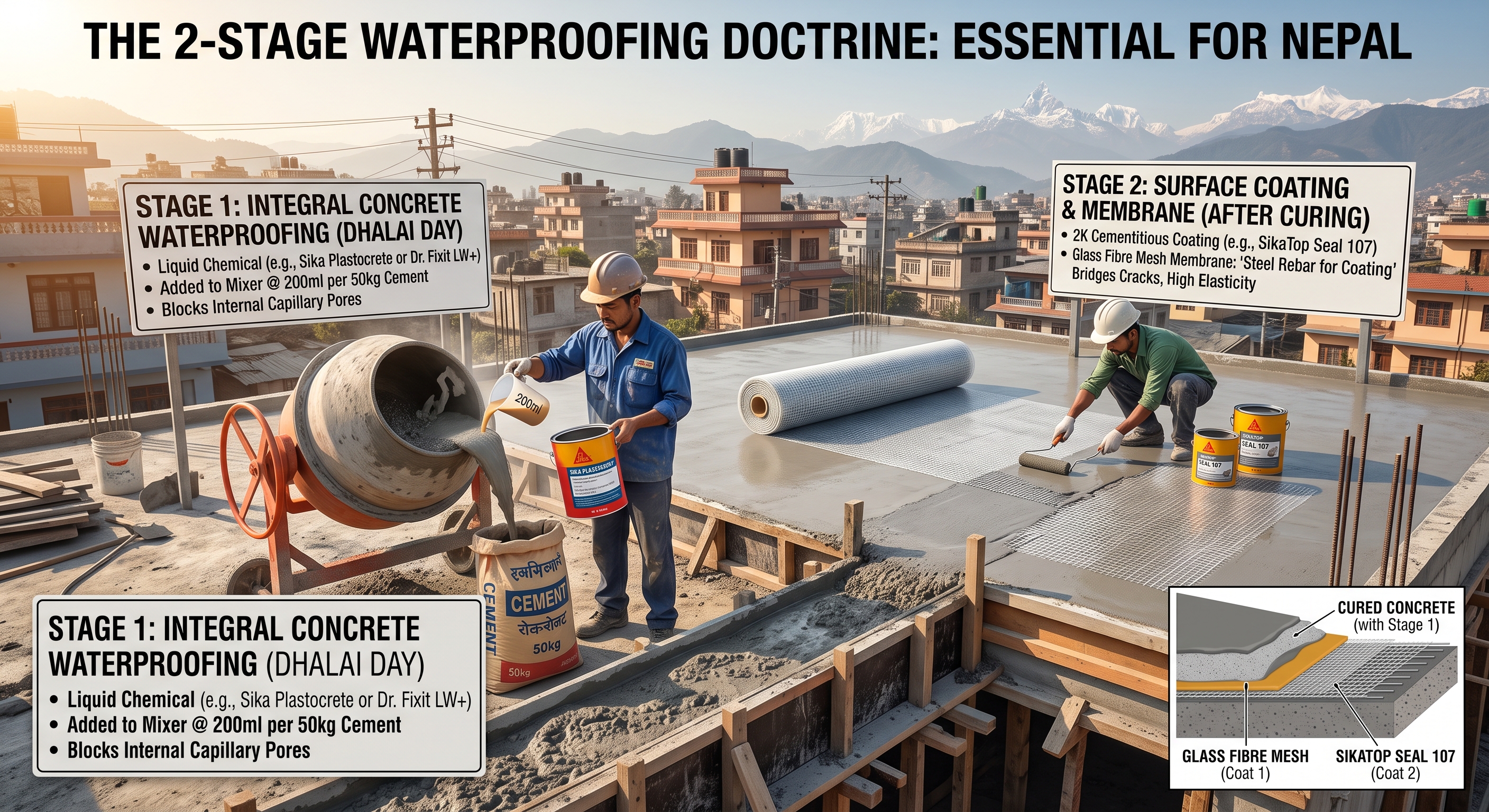
The biggest mistake self-builders in Kathmandu and Pokhara make is relying on a single chemical. Concrete naturally shrinks, creating micro-cracks. A true waterproofing system requires two distinct stages:
Stage 1: Stage 1: Integral Concrete Waterproofing (Dhalai Day): Liquid chemicals (like Sika Plastocrete or Dr. Fixit LW+) are added directly to the mixer at exactly 200ml per 50kg cement bag. This blocks the internal capillary pores and reduces the water needed for the mix, ensuring maximum structural strength without voids.
Stage 2: Stage 2: Surface Coating & Membrane (After Curing): Integral chemicals cannot bridge physical cracks caused by earthquakes or thermal expansion. After the slab cures, a 2K (Two-Component) Cementitious Coating (like SikaTop Seal 107) must be applied to the surface. Crucially, a Glass Fibre Mesh Membrane is sandwiched between the two coats. This mesh acts like 'steel rebar for the coating', giving it the elasticity to stretch without tearing when the roof expands in the hot sun.
2. Area-Specific Defense Strategies
☔ A. Roof Slabs (Terrace)
The roof takes the brutal force of the monsoon. Follow the complete 2-stage doctrine. After Stage 2 (Membrane + Coating) dries, it must be protected by screed concrete (screed with slope 1:100 toward drains) before laying terrace tiles.
🧱 B. Zero-Side (Blind Walls)
In dense urban areas, your house may touch the neighbor's property line (Zero-Side). Because you cannot plaster the outside later, moisture will easily pass through the raw bricks into your rooms. Solution: As the masons lay the bricks, they must mix SBR Latex into the mortar AND apply a thick elastomeric/bitumen coating to the outer face of the bricks step-by-step before the gap is closed forever.
🛁 C. Sunken Bathrooms
Bathrooms hold standing water constantly. Apply the 2K Coating + Membrane on the floor, but crucially, extend the coating at least 1 foot (300mm) up the surrounding walls (flashing) to create a seamless waterproof 'tub'. Ensure all plumbing pipe penetrations are sealed with swelling polyurethane sealants.
📐 D. Parapet Walls (The Gola Technique)
The 90-degree corner where the flat roof slab meets the vertical parapet wall is a massive weak point. Concrete expands and shrinks, cracking this joint. Solution: Construct an 'Angle Fillet' (locally called a Gola)—a curved slope of cement mortar mixed with SBR Latex—to smooth out the 90-degree corner before applying the membrane coating over it.
3. Brand Comparison: Sika vs. Dr. Fixit in Nepal
Both brands offer complete systems. Here is how their specific product lines match up for the 2-Stage method:
| System Component | Sika (Swiss Tech, Premium Grade) | Dr. Fixit (Pidilite, Standard Grade) |
|---|---|---|
| Stage 1: Integral Dhalai Liquid | Sika Plastocrete Plus | Dr. Fixit LW+ |
| Stage 2: 2K Coating (Base) | SikaTop Seal-107 | Dr. Fixit Fastflex / Pidifin 2K |
| Stage 2: Reinforcing Membrane | Sika Glass Fibre Mesh | Dr. Fixit Roofseal Mesh |
| Polymer Additive (SBR for Gola/Mortar) | SikaLatex Power | Dr. Fixit Super Latex |
4. The 'Mistri Water Trap' & Why Curing is Non-Negotiable
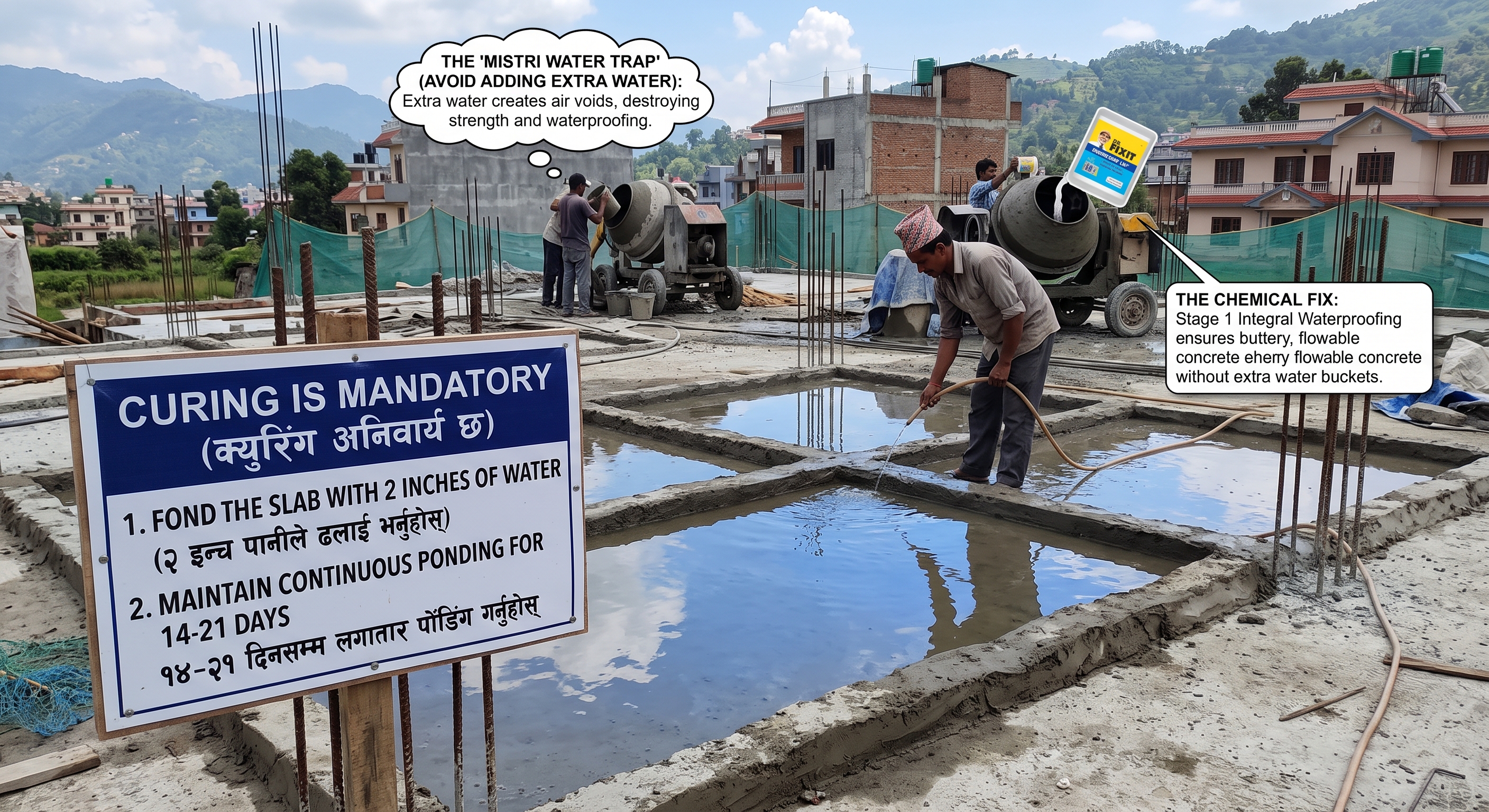
Local laborers (mistris) hate stiff concrete. To make their job easier during Dhalai, they often secretly add extra buckets of water to the mixer. As this extra water evaporates, it leaves billions of air voids inside your pillars, destroying the concrete's strength and waterproofing.
The Chemical Fix: Integral chemicals (Stage 1) make the concrete buttery and highly flowable without adding a single drop of extra water.
Mandatory Ponding (Curing): Even with the best chemicals, if the slab surface dries quickly in the sun, it shrinks and develops structural cracks. You must construct small sand bunds (Kyari) and flood the roof with 2 inches of standing water for 14 to 21 continuous days.
Waterproofing Material Estimator
Select an area of your house and input the square footage (or linear feet for parapets) to calculate exactly what chemicals and membranes you need.
Estimated Procurement:
Requires 9 standard 20kg combo kit(s) and 3 roll(s) of 50m reinforcing mesh.
Required Material System:
2K Cementitious Coating (e.g., SikaTop Seal 107) + Glass Fibre Mesh Membrane
Application Method:
Apply 1st coat, immediately embed the glass fibre mesh flat, let dry, then apply 2nd cross-coat.
Frequently Asked Questions
Q: Can I skip the glass fibre membrane and just paint the 2K coating?
You can, but it is highly risky for flat roofs. The concrete slab will expand in the summer heat and contract in the winter. Without the glass fibre mesh embedded inside, the chemical coating will eventually tear along with the concrete's micro-cracks.
Q: How do I waterproof a zero-side wall if the neighbor's house is already built tightly against it?
If the gap is zero, you must waterproof from the inside (Negative Side Waterproofing). This involves removing interior plaster, applying a specialized negative-side crystalline coating (like SikaSeal), and re-plastering with SBR-modified mortar.
Q: Why is water pooling around my parapet wall corners?
Because the roof slope (screed) is incorrect, and the 90-degree corner lacks a 'Gola' (angle fillet). Water pools at the 90-degree crack and seeps directly into the ceiling edges below.