Ready-Mix Concrete (RMC) vs. Manual Site Mixing in Nepal
Should you order a transit mixer truck or mix concrete by hand on-site? Uncover the true costs, urban logistical challenges, and the shocking reality of site-mixed concrete quality in Nepal.
M20 Direct Rate
RMC is Cheaper
NPR 11,000/m³ (RMC) vs NPR 11,450/m³ (Manual) due to zero site wastage.
The Catch (Pump Cost)
NPR 12k - 15k Flat
You must pay a flat pump charge, making RMC pricier for tiny pours (<10m³).
Time Saved
3 Hrs vs 12 Hrs
A standard 20m³ roof slab finishes in 3 hours with RMC. Manual takes all day.
1. The 'Mistri Water Trap': Why Manual Mix Often Fails
Under the updated NBC 105:2020 seismic codes, the steel cages inside your 14x14 inch pillars are incredibly dense (packed with 16mm rebar and heavy 135-degree ties).
The Manual Reality: Local laborers (mistris) hate stiff concrete because it is physically exhausting to push through tight steel rings. To make their job easier, they secretly add buckets of extra water into the site mixer to make the concrete flow smoothly (increasing the 'slump').
The Disastrous Result: As this extra water evaporates, it leaves billions of microscopic air voids inside your pillars. Adding just a few extra buckets of water can plummet your M25 concrete down to a highly fragile M15 strength, making it extremely vulnerable to earthquake shearing.
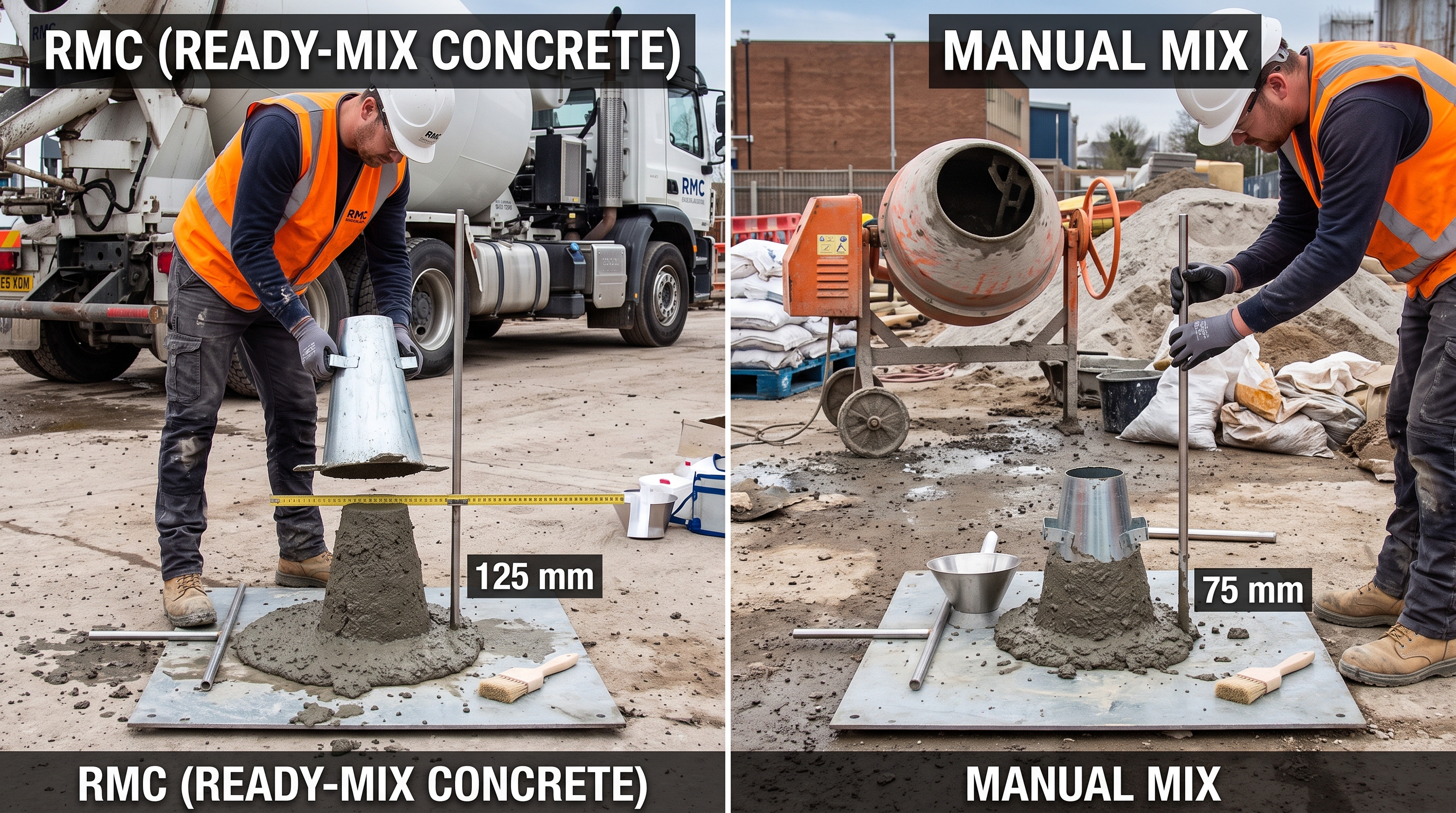
The RMC Solution: Ready-Mix Concrete batching plants solve this with chemistry, not water. They use computerized batching and add special chemical 'Plasticizers'. This makes the concrete buttery and highly flowable for the mistris without adding a single drop of extra water, perfectly preserving the maximum M25 compressive strength.
2. The True Cost Breakdown: 1 Cubic Meter (M20 Grade)
Standard rates in Kathmandu/Lalitpur (assuming 1 m³ = 35.31 Cubic Feet). Note that manual mixing suffers a mandatory 5-8% material wastage factor.
| Material / Service | Manual Mix (On-Site) | Ready-Mix Concrete (RMC) |
|---|---|---|
| Cement (OPC/PPC) | 8 Bags @ NPR 750 = NPR 6,000 | Included in batch |
| Sand & Aggregate | NPR 3,550 (approx. 45 cft combined) | Included in batch |
| Site Wastage (7%) | NPR 670 (Sand blown/washed away) | NPR 0 (Exact volume delivered) |
| Labor & Mixer Rent | NPR 1,230 (Mixer fuel, daily wages) | Included in pump charge |
| Base Raw Cost / m³ | NPR 11,450 | NPR 11,000 |
3. The Nightmare of Urban Logistics in Nepal
While RMC guarantees exceptional quality and is highly cost-effective for larger pours, getting it to your plot is the biggest challenge in developing municipalities.
🚛 The Alley Width Problem
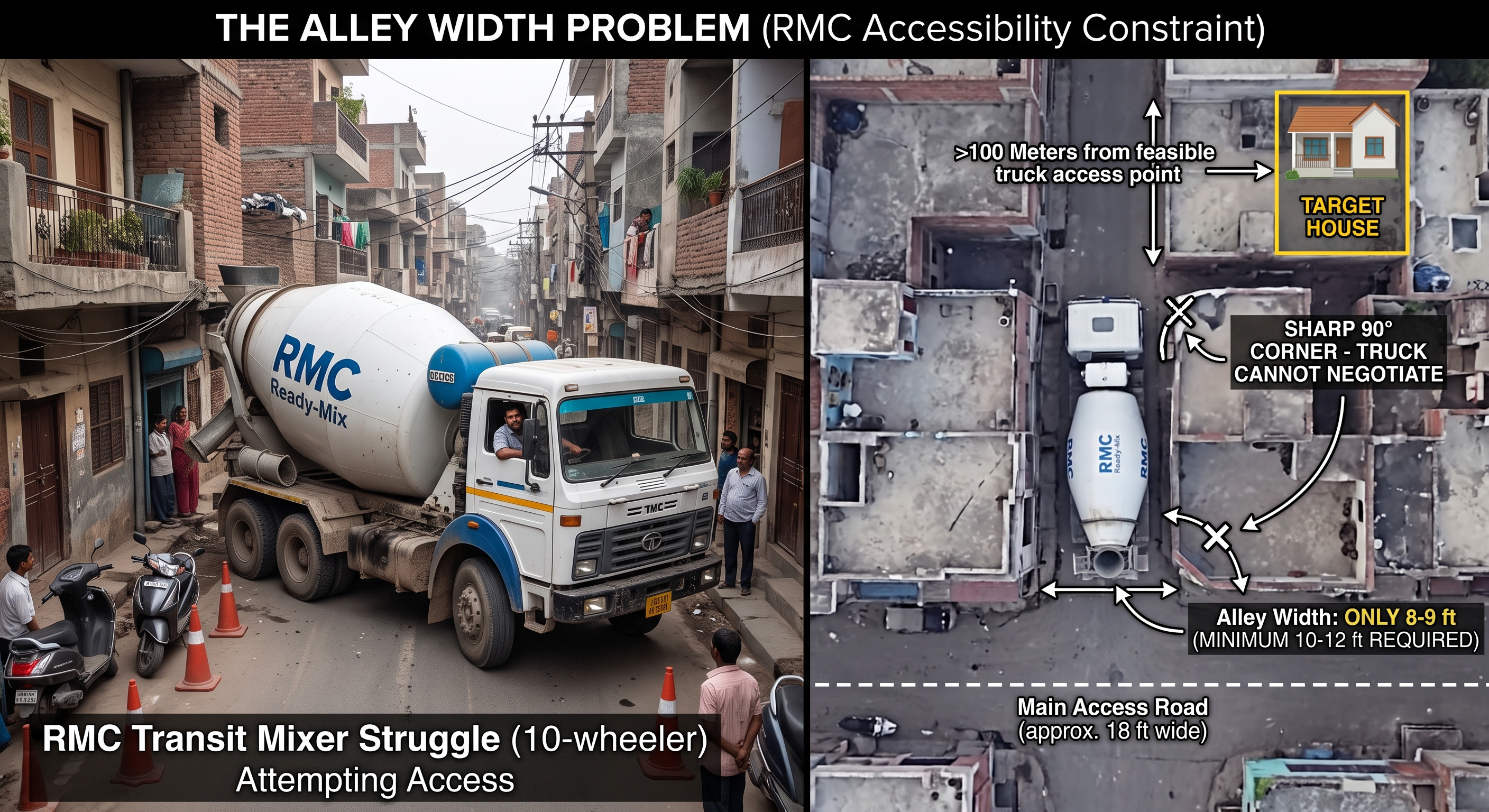
Alley Width (The Gulli Problem): RMC transit mixer trucks are massive (6-wheelers or 10-wheelers carrying 6 to 8 cubic meters). Your access road must be at least 10 to 12 feet wide with absolutely no sharp 90-degree corners. If a truck cannot reach within 50 to 100 meters of your house, RMC is impossible.
🏗️ Pipe Pumps vs. Boom Pumps
Pipe Pumps vs. Boom Pumps: A Boom Pump (truck with a robotic crane arm) requires wide open space above to avoid hanging NEA electricity wires. Most Kathmandu self-builders rely on Line (Pipe) Pumps. Workers manually lay heavy steel pipes through narrow alleys up to 100+ meters from the parked truck to the pouring site.
⏳ The 90-Minute Window
The 90-Minute Window: RMC has a ticking clock. From the moment water touches cement at the factory, the truck must reach your site and pump the concrete into your slab within 90 to 120 minutes. Traffic jams in Koteshwor or Kalanki can ruin a batch, which is why most RMC slab pours in Kathmandu happen late at night or early morning.
Concrete Slab / Pillar Cost Calculator
Slide to adjust the total cubic meters needed for your slab or foundation pour. See exactly when RMC becomes cheaper than mixing on-site.
Recommendation:
Manual mixing is cheaper for this small volume (RMC pump cost makes it expensive).
Cost Difference: NPR 6,750
Cement bags you'd have to buy & store manually: 128
Frequently Asked Questions
Q: Can I use RMC for just my pillars, or is it only for roof slabs?
You can, but it is rarely economical. Pillars require small volumes of concrete (often 2 to 4 m³ total per floor). Paying the NPR 12,000 - 15,000 flat pump charge for just 3 m³ makes RMC extremely expensive per cubic meter. RMC is best reserved for massive continuous pours like foundations and roof slabs.
Q: Do I still need a vibrator machine if I use RMC?
Absolutely YES. RMC is highly flowable, but you must still plunge an electric vibrator into the pillars and slab to push out trapped air bubbles and ensure the concrete tightly grips the steel rebar.
Q: How do I calculate how many cubic meters my roof slab needs?
Multiply your roof's Length (in meters) x Width (in meters) x Thickness of the slab (usually 0.127 meters or 5 inches). Add an extra 15-20% volume for the depth of the concealed beams. A typical 1,000 sq.ft. house needs roughly 15 to 18 cubic meters per floor.