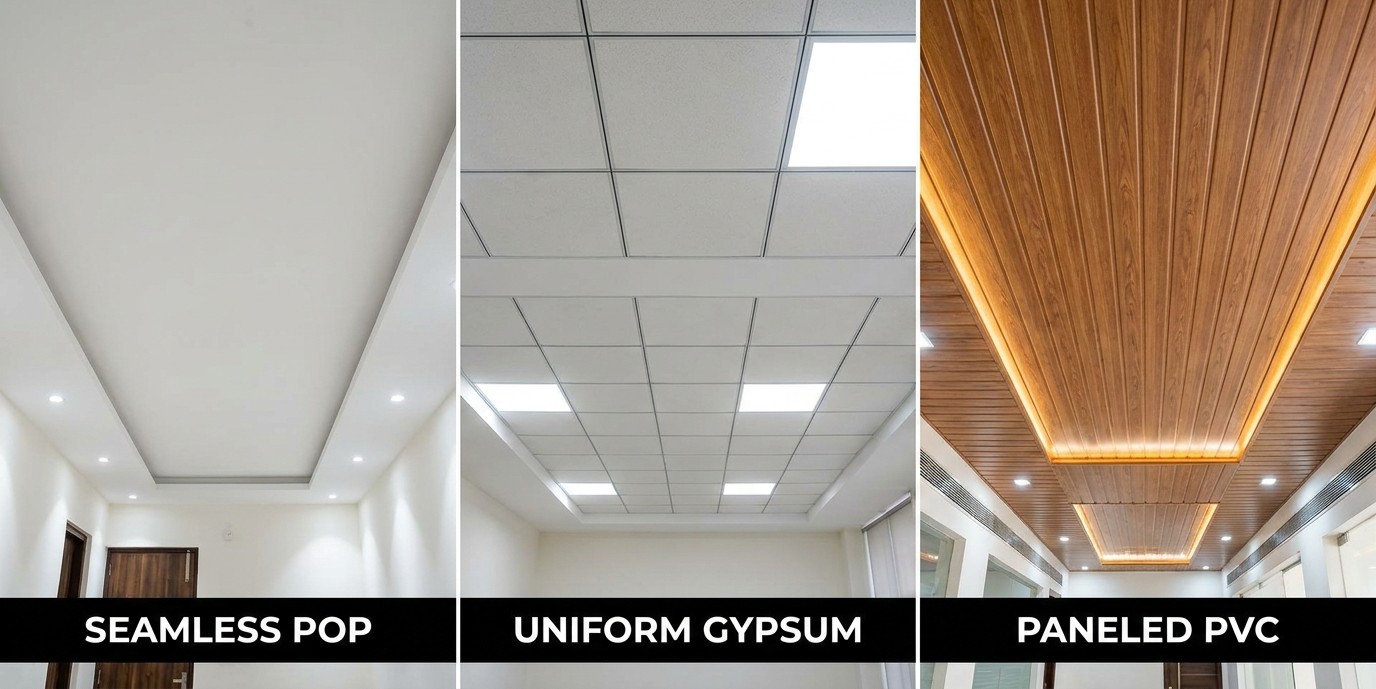
1. POP (Plaster of Paris) - The Highly Custom Option
POP comes as a powder that is mixed with water to form a paste. It is applied to a chicken mesh (Jali) attached to a metal framing. Because it is molded on-site, a skilled Mistri can create highly intricate, curved, and seamless designs.
- Pros: Seamless finish, highly durable (if kept dry), can be molded into any shape or curve.
- Cons: Messy and dusty installation, takes longer to dry, and will easily crack or crumble if water leaks from the roof.
- Best For: Living rooms and master bedrooms requiring premium, curved aesthetics.
2. Gypsum Board - The Fast & Clean Standard
Gypsum boards are factory-manufactured sheets (usually 6x4 ft or 8x4 ft) consisting of a gypsum core wrapped in paper. They are screwed directly into a metal framework. This is the most popular choice for modern houses in Nepal due to its speed and clean finish.
- Pros: Very fast installation, minimal dust, factory-smooth finish, excellent for straight-line designs.
- Cons: Standard boards are damaged by moisture (though green moisture-resistant boards are available), and joints can show fine cracks over time if taping is done poorly.
- Best For: Standard bedrooms, corridors, and commercial offices.
3. PVC Panels - The Waterproof Budget Saver
Polyvinyl Chloride (PVC) panels are lightweight, interlocking plastic sheets. They come pre-finished in various colors and wooden textures, meaning they do not require any painting or putty after installation.
- Pros: 100% waterproof, termite-proof, very cheap, installs in a day, and requires zero painting.
- Cons: Has a distinct 'plastic' look, panel joints are clearly visible, and cheap panels can sag or warp in extremely hot rooms (like directly under tin roofs).
- Best For: Bathrooms, balconies, kitchens, and damp basement areas.
Quick Comparison Summary
| Feature | POP | Gypsum Board | PVC Panels |
|---|---|---|---|
| Est. Cost (Per Sq.Ft)* | NPR 130 - 160 | NPR 110 - 140 | NPR 90 - 120 |
| Moisture Resistance | Very Poor | Moderate (Poor if standard) | Excellent (100% Waterproof) |
| Installation Speed | Slow & Messy | Fast & Clean | Very Fast |
| Aesthetic Finish | Premium Seamless | Clean Straight Lines | Basic (Joints Visible) |
* Rates are approximate estimates in Nepal, including labor and framing. Painting costs for POP/Gypsum are extra.
⚠️Crucial Ceiling Warning (Seepage):Never install POP or Gypsum ceilings directly under a top-floor roof (Chhat) if there is any history of water seepage. Even a tiny roof leak during the monsoon will completely dissolve and collapse a POP/Gypsum ceiling. Fix the waterproofing on your roof first, or opt for PVC panels in high-risk moisture zones.