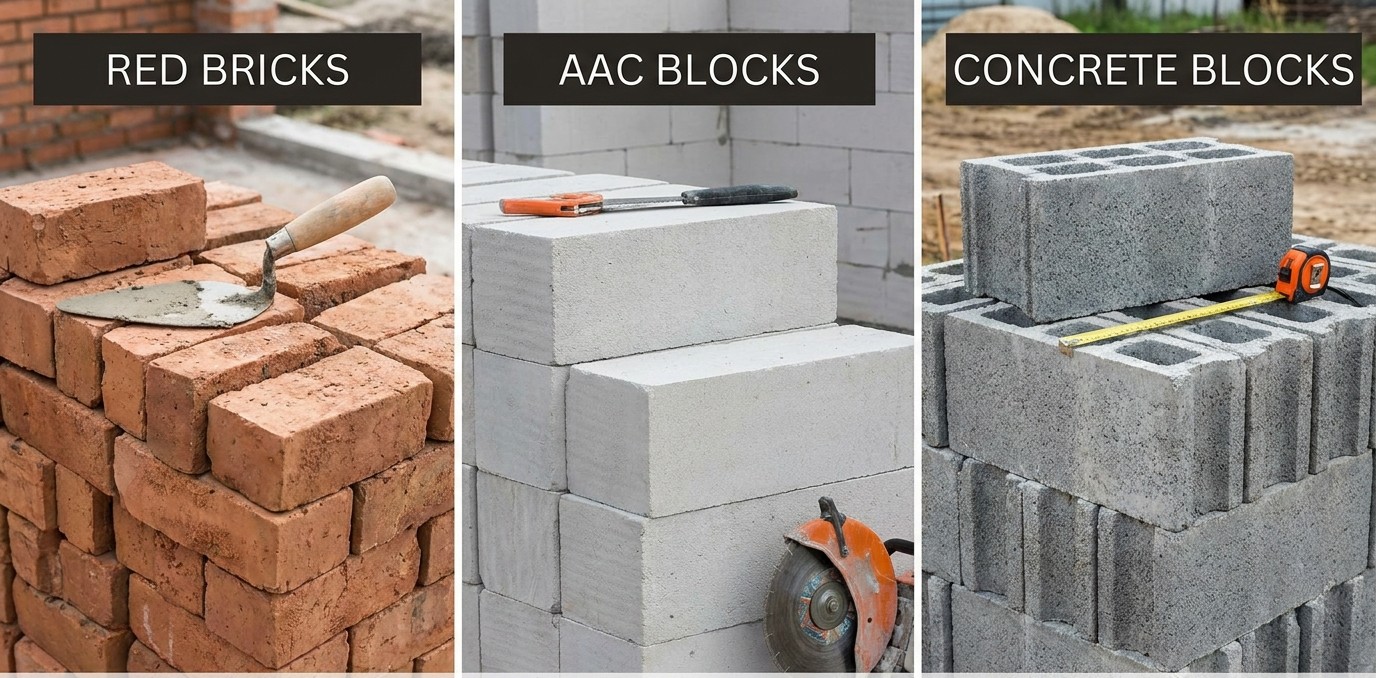
1. Traditional Red Clay Bricks
Red clay bricks are the most trusted and commonly used building material across Nepal. According to IS 1077 and local Nepal Building Code (NBC) guidelines, Class A bricks provide excellent compressive strength and high durability. However, they are heavy, which adds significant 'dead load' to the structural beams and columns.
- Best For: Load-bearing walls, exposed brick aesthetics, and wet/damp areas like bathrooms and foundation soling.
2. AAC Blocks (Autoclaved Aerated Concrete)
AAC blocks are rapidly becoming the preferred choice in Kathmandu and major urban centers. Governed by IS 2185 (Part 3), these blocks are manufactured with millions of tiny air pores, making them up to 3 times lighter than traditional clay bricks. This dramatically reduces structural weight during earthquakes. Furthermore, they offer exceptional thermal insulation, keeping your home cooler in the summer and warmer in the winter.
- Best For: Internal partition walls in framed structures, multi-story buildings, and temperature-controlled rooms.

3. Concrete Blocks (Solid & Hollow)
Concrete blocks are available in both solid and hollow variations, specified under IS 2185 (Part 1). Hollow blocks are highly cost-effective and make running electrical conduits or plumbing pipes very easy. While they don't have the thermal benefits of AAC, their immense strength makes them excellent for boundary walls or construction in the Terai region where clay brick quality might be inconsistent.
- Best For: Boundary walls, commercial buildings, and low-cost load-bearing structures.
Quick Comparison: Cost, Strength & Thermal
| Feature | Red Brick | AAC Block | Concrete Block |
|---|---|---|---|
| Dead Weight | Heavy | Very Light | Medium-Heavy |
| Strength | High | Moderate | High |
| Thermal Insulation | Poor | Excellent | Moderate |
| Construction Speed | Slow | Very Fast | Fast |
| Mortar Required | High | Very Low | Medium |
⚠️Crucial Construction Warning:When using AAC blocks, your Mistri MUST use specialized chemical block adhesive (polymer mortar) instead of regular cement-sand mortar. Regular sand mortar will not bond properly with AAC blocks and will lead to severe wall cracking. Additionally, AAC walls require a protective plaster coat promptly to prevent moisture damage from monsoon rains.